Controller input lag is the delay between moving a stick or pressing a button and seeing the result on screen. Most of it comes from three places: the wireless link (Bluetooth typically adds ~5–15ms over wired), the display (TVs often add 20–50ms without game mode), and the game's own frame processing. Fix the link first, then the display.
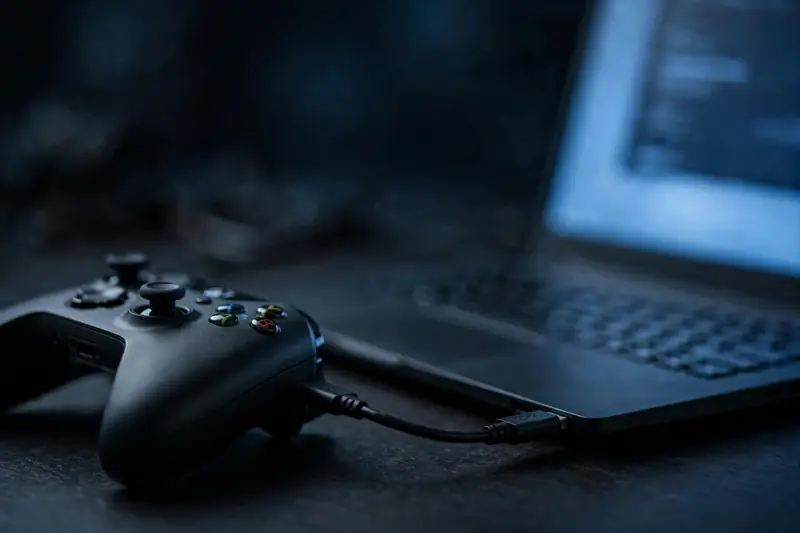
What causes controller input lag?
Input lag is the sum of every delay in the chain: controller sensor → wireless/wired transmission → OS and driver processing → game engine → GPU render → display output. No single step dominates for everyone, which is why "my controller feels laggy" has several possible fixes.
The controller's own contribution is usually the smallest part. Polling rate (how often the controller reports its state), wireless protocol overhead, and Bluetooth interference set the floor. The display is frequently the biggest offender — a TV in standard picture mode can add more delay than everything else combined.
Before changing anything, isolate the problem: if the delay feels the same with a wired connection on a gaming monitor, the cause is likely the game or system, not the controller.
Display lag deserves its own check because it is so often the real culprit. A TV in standard picture mode commonly adds 30–60ms of processing; game mode typically cuts that to under 20ms, and a good gaming monitor sits around 5–10ms. If you play on a TV without game mode enabled, fixing the display alone can remove more delay than every controller-side tweak combined.
You can roughly measure total system latency yourself: film the screen and controller in slow motion (240fps phone video works), press a button, and count frames between the press and the on-screen response. Each frame at 240fps is about 4.2ms. It is not lab-grade, but it tells you whether you are fighting 30ms or 130ms.
Is Bluetooth slower than wired?
Yes, measurably — though often less than people fear. A wired USB connection is the baseline. Bluetooth typically adds roughly 5–15ms of extra latency depending on the adapter, environment, and controller, while a dedicated 2.4GHz wireless dongle usually sits between wired and Bluetooth.
The bigger Bluetooth problem is consistency, not averages. Interference from Wi-Fi routers, microwaves, and other Bluetooth devices causes latency spikes and momentary disconnects that feel far worse than a stable extra 10ms. Averages hide this; players feel the spikes.
For competitive play, wired is the safe choice. For casual gaming on a couch, a clean Bluetooth connection is usually fine — "clean" being the operative word.
Battery level matters more than people expect. A nearly depleted controller can exhibit increased latency and more frequent micro-dropouts as the radio struggles. If lag appears only late in sessions, charge the controller and re-test before blaming the protocol.
How do I reduce input lag?
Work through these in order, testing after each change. Most players fix the problem by step three.
- Go wired. Connect via USB and re-test. If the lag disappears, the wireless link was the cause — decide whether the tradeoff is worth it for your setup.
- Use a 2.4GHz dongle instead of Bluetooth if your controller supports one (Xbox Wireless Adapter, 8BitDo dongle). Dongles use a dedicated protocol with lower, more stable latency than generic Bluetooth.
- Kill interference. Move the Bluetooth receiver away from the PC case, keep line-of-sight to the controller, switch your router's nearby devices to 5GHz Wi-Fi, and move other Bluetooth peripherals away during play.
- Enable game mode on your TV. This single setting often removes 20–40ms of display processing. On a monitor, use the lowest-latency preset and the highest refresh rate available.
- Reduce render delay. Disable V-Sync if you can tolerate tearing, cap frame rates to match your display, and use your GPU vendor's low-latency mode (NVIDIA Reflex / AMD Anti-Lag) in supported games.
- Update firmware. Controller and receiver firmware updates regularly improve wireless stability — check the Xbox Accessories app, PlayStation system software, or the manufacturer's tool.
If you followed our PC connection guide, re-pairing Bluetooth from scratch after a firmware update often clears stale pairing profiles that cause spikes.
Does polling rate matter?
Polling rate is how many times per second the controller reports its state: 125Hz (every 8ms, the console standard) versus 1000Hz (every 1ms, common on PC esports controllers). Higher polling lowers the average wait before an input is picked up.
In practice, the jump from 125Hz to 1000Hz saves a few milliseconds on average — real, but small next to display lag. It matters most to competitive players who have already fixed everything else. Run our polling rate test to see what your setup actually delivers.
Polling rate also interacts with frame rate. At 60fps, each frame lasts 16.7ms, so a 1000Hz controller's 1ms reports mostly wait for the next frame anyway — the benefit shrinks. At 240Hz+ displays, high polling matters more because frames come fast enough to use the fresh data. Match your polling ambitions to your display first.
One honest caveat: a browser-based gamepad tester cannot measure your controller's true USB polling rate — the browser's Gamepad API samples on its own schedule. Treat browser numbers as indicative, not lab-grade.
Frequently asked questions
Why does my controller lag only sometimes?
Intermittent lag is almost always wireless interference or a crowded 2.4GHz band. It spikes when a microwave runs, a large download starts, or another Bluetooth device connects. Wired testing confirms it: if USB is stable, the airwaves are your problem.
Does controller input lag affect single-player games?
Less noticeably, but it still does — camera movement and menu navigation feel mushy. The fixes are identical, though casual players can usually stop at enabling TV game mode and calling it done.
Will a new controller fix my lag?
Only if the old controller's radio or battery is failing. If the lag persists across controllers, the cause is your display, wireless environment, or game settings — a new pad won't change any of those.
Is 2.4GHz dongle always better than Bluetooth?
For latency and stability, yes in most cases — dongles use purpose-built protocols instead of Bluetooth's general-purpose stack. The tradeoff is occupying a USB port and carrying the dongle, which matters for laptop and travel setups.