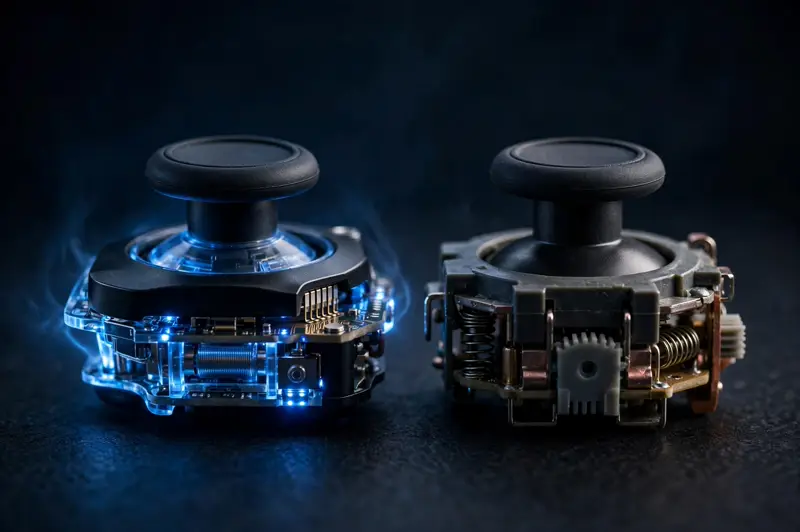
Stick drift happens because most controllers use potentiometer-based sticks: a physical wiper scrapes across a resistive carbon track to measure position, and that contact wears down with use. Hall effect sticks replace contact with magnets — a sensor reads the magnetic field without touching anything, so there is nothing to wear out and drift effectively cannot develop.
Why does stick drift happen?
The vast majority of controllers — including first-party pads as of 2026 — use ALPS-style potentiometer stick modules. Inside each module, a small wiper arm drags across a curved resistive track as you tilt the stick. The controller reads position from the changing electrical resistance.
Every tilt scrapes the wiper against the track a little more. Over months of play, the resistive carbon coating wears thin or gets contaminated with debris. The resistance at the resting position changes, and the controller starts reporting a position you never commanded — the stick "drifts."
This is why drift correlates with playtime, why aggressive players (fighting games, competitive shooters) see it first, and why cleaning sometimes helps temporarily: you are removing debris, not restoring worn carbon.
What is Hall effect sensing?
Hall effect sticks measure position with magnets instead of contact. A small magnet sits on the stick shaft; a Hall effect sensor on the circuit board detects the magnetic field's angle as the stick tilts. No parts touch, so there is no friction surface to degrade.
The practical result: the sensor reads the same at hour one and hour ten thousand. Hall effect sticks can still fail from broken solder joints or damaged magnets, but the gradual wear-based drift that kills potentiometer sticks does not occur.
Power consumption is another quiet advantage. Potentiometers draw current through the resistive track continuously, while Hall sensors sip power — one reason Hall-equipped controllers often post slightly better battery life in otherwise identical designs. It is a small effect, but it compounds over long wireless sessions.
There are tradeoffs. Hall modules cost more, and early third-party implementations had slightly different centering feel that some players disliked. The technology is proven, though — it has been used in industrial joysticks for decades.
Which controllers use Hall effect sticks?
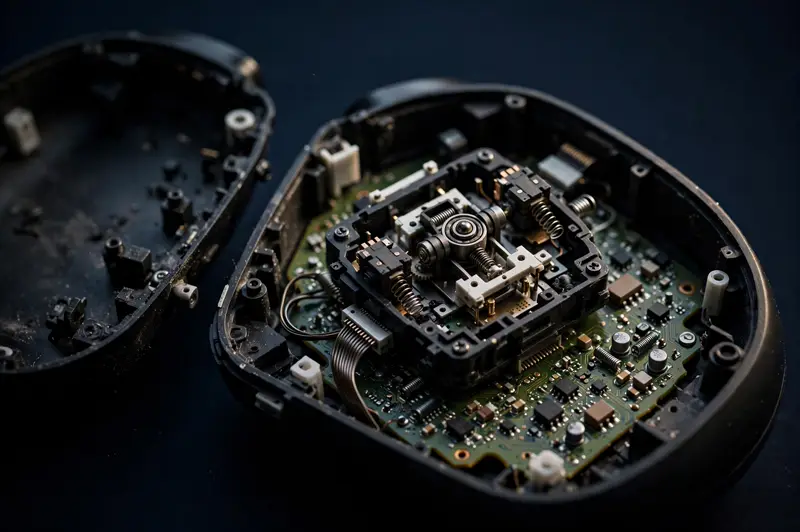
As of 2026, most first-party controllers — including the DualSense and Xbox Wireless Controller — still ship with traditional potentiometer sticks. The shift is happening in the third-party market first.
8BitDo has released Hall effect variants of several controllers, and Gulikit's KingKong line was built around Hall sensing from the start. A growing number of Gulikit replacement modules also let you retrofit Hall sticks into popular controllers. If drift-proofing matters to you, check the spec sheet for "Hall effect" or "anti-drift" sticks before buying — manufacturers now advertise it prominently because buyers ask.
Do not assume: some controllers marketed as "pro" or "elite" still use potentiometers. The sensor type is a separate spec from the price tier.
When shopping, look beyond the marketing. Terms like "anti-drift," "drift-free," and "electromagnetic" all signal contactless sensing, while listings that say nothing about the stick technology almost certainly use traditional potentiometers. Reviews from teardown channels are the most reliable source when the spec sheet is vague.
Can I upgrade my controller to Hall effect sticks?
Yes, on many controllers — but it is a soldering job. Gulikit and similar Hall effect replacement modules are designed as drop-in electrical replacements for ALPS stick modules, meaning the pinout matches. You desolder the old module and solder the new one in its place.
Before attempting it, run a stick drift test to confirm which stick is actually drifting — replacing the wrong one wastes the effort. After the swap, re-test and check that both axes rest near 0.00 and reach full deflection smoothly.
Expect a break-in nuance: fresh Hall modules sometimes report a slightly different center than the original sticks, so run the game's or system's calibration routine after installation even if the old sticks never needed one. One careful calibration at install time usually holds permanently, since there is no wear mechanism to shift it later.
- Skill needed: confident through-hole desoldering; stick modules have many pins and nearby plastic melts easily.
- Warranty: opening the controller voids it on virtually every brand.
- Calibration: some modules need a centering calibration after install — check the module's instructions.
- Alternative: if soldering is out of reach, a drift fix guide covers cleaning and deadzone mitigation, and our used controller checklist helps you buy a replacement that is actually healthy.
Frequently asked questions
Do Hall effect sticks ever drift?
Wear-based drift, no — there is no contact surface to wear. They can still misbehave from manufacturing defects, magnet displacement after a hard drop, or firmware issues, but these are rare and sudden rather than gradual.
Why don't all controllers use Hall effect already?
Cost and supply chain inertia. Potentiometer modules are fractions of a dollar at console-manufacturing scale with decades of tooling behind them. As Hall module prices fall and buyers demand drift resistance, adoption is accelerating.
Is TMR the same as Hall effect?
Not exactly. TMR (tunnel magnetoresistance) is a newer magnetic sensing technology that is even more precise and power-efficient than classic Hall sensors. Gulikit's latest modules use TMR. For the buyer, both mean the same thing: contactless, drift-resistant sticks.
Can software detect whether my sticks are Hall or potentiometer?
No — the Gamepad API reports axis values identically either way. The sensor type is invisible to software; check the manufacturer's spec sheet or open the controller to see the module markings.